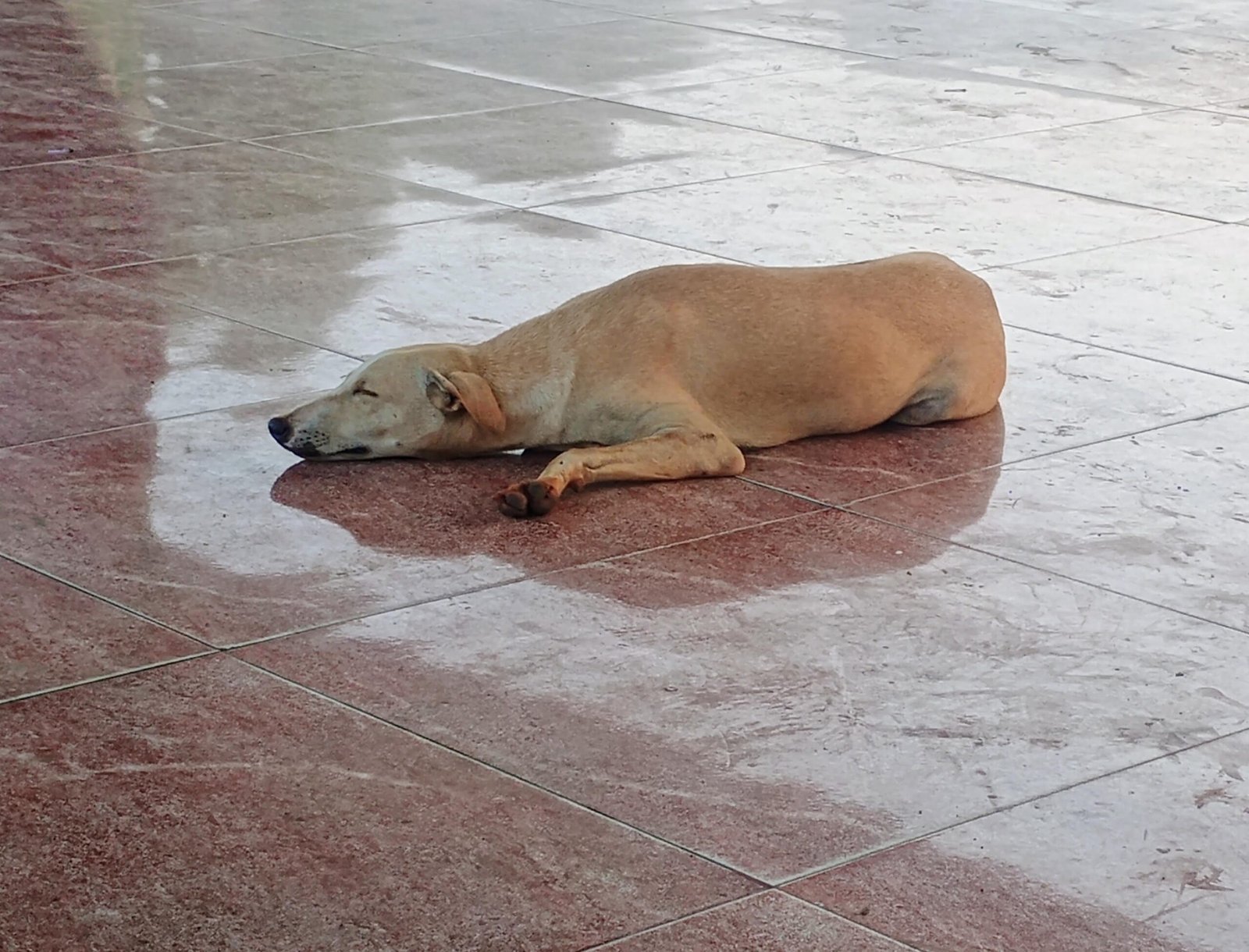
Have you ever seen a dog sleeping peacefully like the one above and said: “Huh, what a life he or she is living! Such a lucky guy. But look at me. What a pitiful human existence!”
Apart from the self-pity involved in this state of mind, the interesting thing here is how our comparison apparatus has moved from humans-humans to animals-humans. It is a real slip from the status quo, where we are all participating. Through comparison between human beings, we ingest the values that sustain the very status quo and let it function properly.
What kind of slip is it? What does the slip tell us? What does this new comparison apparatus signify?
It is a perceptual discrepancy between the animal’s indifference towards life and the importance we attach to life. As we treat every day as a stepping stone towards a goal, we encounter a dog that lives without thinking about the future, lives every moment as it is, and we reflect on our life as a drudgery compared to it.
This temporal selection of our life and its placement into the hierarchy of life-fulfillment blinds us to the line of choices that we made, leading us to the current point. Life is made up of a web of lines, so to speak. As we choose the line of joy, this line is not filled with merely points of joy, but also with pain and sadness. But it is justified as it presupposes and enriches joy and happiness.
Nietzsche said as follows: “The plethora of kinds of suffering falls down like an infinite blizzard on such a human being, just as the strongest lightning flashes of pain discharge on him. Only in this condition—always open to pain from all sides and down to the deepest level—can he be open to the subtlest and highest kinds of happiness.” It becomes clear that happiness and sadness do not occupy separate dwellings where we can selectively visit one and lock out the other. They are structurally intertwined. It is not about eulogizing pain, but the thing is, in the process of discarding pain, we will discard happiness as well.
Isolation of pain leads us to all kinds of comparisons, whether it is with humans or animals. And, more importantly, today, we embrace the futureless existence. It is because the future has turned out to be a horizon of achievement, rather than a horizon of novelty. It makes us feel pressured when we think about the future, rather than inspired and able to dream.
Alfred North Whitehead pinpoints, “The modern tendency is to say, ‘I am happy now. The future does not matter!’ but the ‘now’ is meaningless without a significant future. What is wanted is to relate all the ‘nows’ with the future.” The future is the offspring of the present. If we compulsively remove the future from the temporal framework, the present turns into a state of impotence.
If the predeterminative perception takes a step back from our existence, whenever we encounter a sleeping dog, we can peacefully sit beside him with eyes of bliss.